Three German Invasions of France: The Summer Campaigns of 1870, 1914 and 1940 by Douglas Fermer
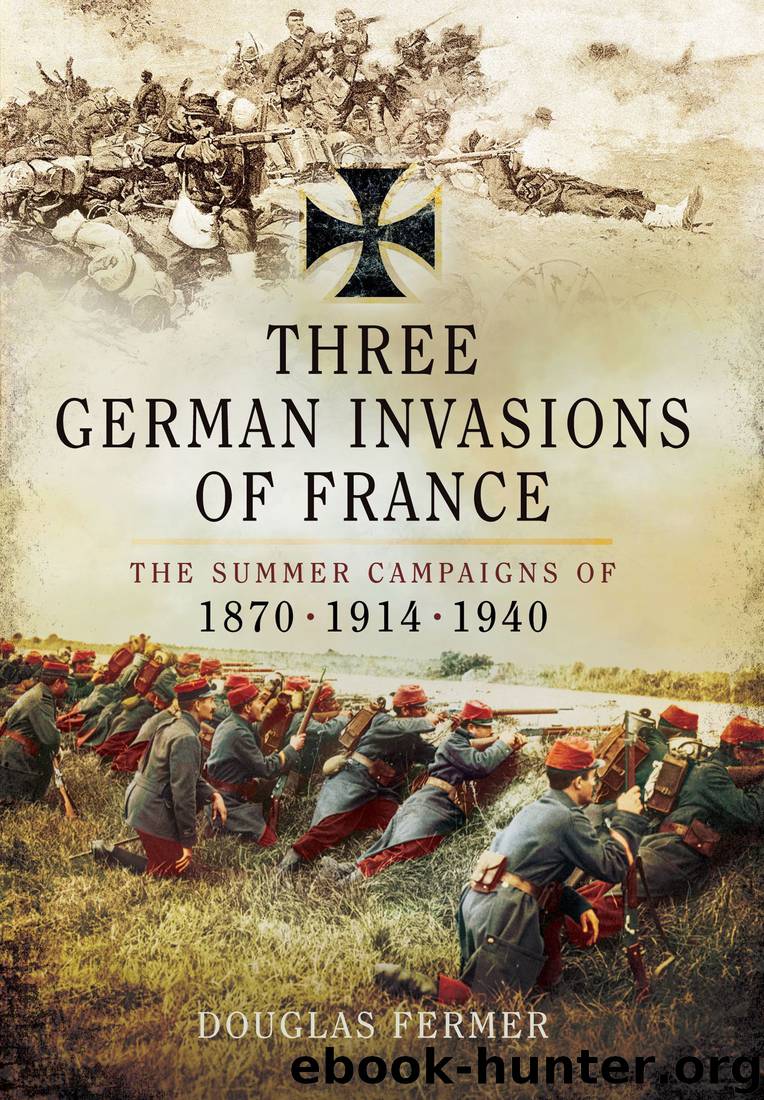
Author:Douglas Fermer [Fermer, Douglas]
Language: eng
Format: epub
Tags: Campaigns & Battles, World Wars, Modern Warfare, Politics, Strategy
ISBN: 9781781593547
Amazon: 178159354X
Goodreads: 19157082
Publisher: Pen & Sword
Published: 2014-02-19T05:00:00+00:00
Part III
1940:
The Collapse
Night fell slowly. The leaden sky glowed red. Some of the men wondered whether war had already been declared … Then in the silence a woman began weeping and wailing … We could no longer doubt it. The war had begun.
Georges Sadoul, Metz, 3 September 1939
Chapter 13
In Search of Security
The scale of the killing in the Great War cast a shadow over a generation, marking the survivors and the families and friends of the dead as they grappled with its consequences for their own lives, for their communities and for France. The cold as marble figures still possess a bleak eloquence that defies commentary. In four years France had mobilized 8,410,000 men, roughly a fifth of her population and a greater proportional effort than any other major power.1 The total of French servicemen who had died was established after the war as 1,397,800, or approximately one-sixth of those mobilized.2 By one computation this meant that during the four years of the war on average 890 French servicemen died every day.3 The French loss of nearly 1.4 million men compared to Germany’s over 2 million, Russia’s 1.8 million, Austria-Hungary’s 1.1 million, the United Kingdom and British Empire’s combined 921,000, Italy’s 578,000 and the USA’s 114,000.4 In addition, 806,000 French soldiers had been invalided out for serious wounds and 2,800,000 were classified as wounded, even excluding those lightly wounded men who had returned to their units after a few days. Half the wounded had received two wounds.5 As in every European country, severely disabled and disfigured men were to be a common sight for years to come. Less visible was the immense weight of grief and mourning which strove to find expression in the proliferation of national and local war memorials in the post-war years. Civic war memorials alone numbered over 36,000 in France, where the war left at least 630,000 widows and 719,000 fatherless children, counting only those relatives most immediately affected by soldier deaths.6 For the bereaved, as for soldiers maimed in body or mind, the Armistice could bring no end to their suffering.
The material damage in the fought-over and occupied zones was also immense. Large areas of France’s most productive and agriculturally most fertile regions in the north-east had been utterly laid waste. Over 220,000 houses had been destroyed and over 120,000 seriously damaged, along with 62,000 kilometres of road, 5,600 kilometres of railway and 1,800 kilometres of canal, plus hundreds of bridges, mines, factories, schools, churches and other public buildings.7 To fight the war, France had spent some 143 billion francs, almost twenty-nine times her budget of 1914,8 and had incurred a huge national debt through borrowing from her allies.
After such an ordeal, what kind of peace did France want, and was it within her power to attain it? The armistice terms imposed on Germany had reflected the French desire for occupation of the left bank of the Rhine. Some, like Poincaré, argued that the allies should have fought on until they had demonstrably defeated German armies on German soil.
Download
This site does not store any files on its server. We only index and link to content provided by other sites. Please contact the content providers to delete copyright contents if any and email us, we'll remove relevant links or contents immediately.
| Africa | Americas |
| Arctic & Antarctica | Asia |
| Australia & Oceania | Europe |
| Middle East | Russia |
| United States | World |
| Ancient Civilizations | Military |
| Historical Study & Educational Resources |
The Radium Girls by Kate Moore(12028)
100 Deadly Skills by Clint Emerson(4925)
Rise and Kill First by Ronen Bergman(4788)
The Templars by Dan Jones(4689)
The Doomsday Machine by Daniel Ellsberg(4490)
The Rape of Nanking by Iris Chang(4211)
Killing England by Bill O'Reilly(4001)
Stalin by Stephen Kotkin(3965)
Hitler in Los Angeles by Steven J. Ross(3946)
12 Strong by Doug Stanton(3550)
Hitler's Monsters by Eric Kurlander(3342)
Blood and Sand by Alex Von Tunzelmann(3203)
The Code Book by Simon Singh(3189)
Darkest Hour by Anthony McCarten(3133)
The Art of War Visualized by Jessica Hagy(3007)
Hitler's Flying Saucers: A Guide to German Flying Discs of the Second World War by Stevens Henry(2754)
Babylon's Ark by Lawrence Anthony(2678)
The Second World Wars by Victor Davis Hanson(2524)
Tobruk by Peter Fitzsimons(2516)
